
Stop Building Your Own RSS Feed Provider. Here’s What $4.99 Actually Buys You.
- The “quick weekend project” that ate a month
- Why building it yourself seems like the frugal move
- 1. Your time isn’t actually free
- 2. Servers, storage, and the invoice nobody budgeted
- 3. Deduplication turns into a part-time job
- 4. It breaks the one week you’re not watching it
- The actual menu: what $4.99 gets you
- Scaling to 100,000 articles a month without a second mortgage
- Getting started
- FAQ
Somewhere out there, a developer is three weeks into a “quick RSS aggregator,” and it is no longer quick. It started as a single cron job hitting a handful of feeds. Then someone asked for a source that doesn’t publish RSS at all. Then two sources ran the same wire story and the dashboard showed it twice, then four times, then someone opened a ticket asking why “the news” appeared to be repeating itself like a bad sitcom rerun. The problem was never the budget. The problem was treating a content pipeline like a fun little hobby project instead of, well, infrastructure.
This is the pitch for the fastest way out of that hole: a real RSS feed provider, starting at $4.99 a month, that scales to 100,000+ articles without you touching a scraper, a cron job, or a strongly worded Slack message to whoever wrote the dedup logic.
The “quick weekend project” that ate a month
Every homegrown RSS pipeline starts the same optimistic way: “it’s just XML, how hard can it be?” Four weeks later there’s a spreadsheet tracking which of forty sources changed their feed format without telling anyone, a Discord channel dedicated entirely to “is the scraper down again,” and a growing suspicion that maybe, just maybe, this wasn’t actually free.
Why building it yourself seems like the frugal move
On paper, self-hosting looks free. No subscription line item, no vendor to negotiate with, total control over the code. For a single source with a clean, well-behaved feed, that math genuinely holds up — write a parser once, let it run, move on with your life. The trouble starts exactly at the point most projects actually want to go: more than one source.
1. Your time isn’t actually free
Every hour spent debugging a malformed feed, patching a scraper a source’s redesign just broke, or writing yet another edge case for a date format nobody documented is an hour not spent on the product you were actually trying to build. “Free” RSS scraping has a very real hourly rate — it’s just billed in your own time instead of an invoice, which somehow makes it easier to ignore and harder to budget for.
2. Servers, storage, and the invoice nobody budgeted
Polling forty-plus sources on a schedule, storing the results, and serving them back out needs compute and storage that scales with source count — not a one-time cost. It’s rarely dramatic on its own, but stack it against a $4.99/month starting plan that already includes 10,000 requests, and “free” starts looking like the more expensive option once you count the server bill you forgot to mention in the original pitch.
DIY RSS pipeline
Your time debugging feeds, plus server costs, plus the on-call rotation for when it breaks — none of which show up on an invoice, all of which are real.
Managed RSS feed provider
$4.99/month, one API key, 10,000 requests, someone else’s problem when a source changes its format.
3. Deduplication turns into a part-time job
The same story runs on five outlets. Naive scraping returns five near-identical entries for one real event, and now someone’s writing similarity-matching logic to collapse duplicates — a genuinely hard problem that a lot of “quick” RSS projects don’t budget time for until the dashboard is visibly, embarrassingly redundant.
4. It breaks the one week you’re not watching it
RSS pipelines have a talent for failing quietly. A source changes its feed URL, your scraper starts returning empty results, and nobody notices until a stakeholder asks why there’s been no new data in eleven days. A managed feed provider makes source reliability someone else’s monitoring problem instead of a surprise you discover during a demo.
The actual menu: what $4.99 gets you
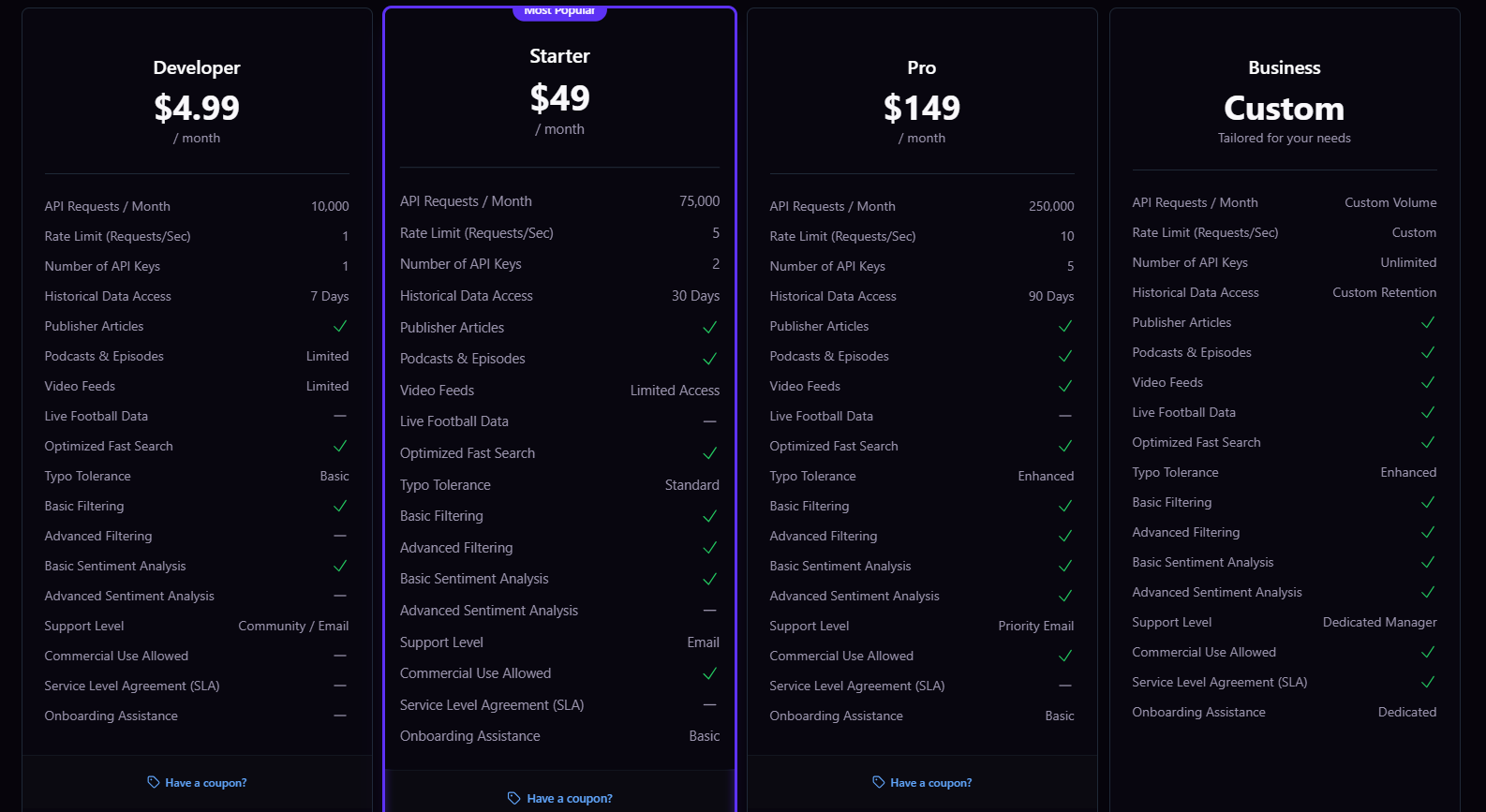
LumenFeed’s Developer plan is $4.99/month for 10,000 requests, 1 request/second, and 7 days of historical data — enough to build and genuinely test a real integration, not just poke at a sandbox. No credit card required to start, and commercial use is included even at this entry tier, which is not universal among RSS feed provider alternatives.
Scaling to 100,000 articles a month without a second mortgage
Here’s the part that tends to surprise people: scaling up doesn’t mean renegotiating your architecture. The Starter plan is $49/month for 75,000 requests, and Pro is $149/month for 250,000 requests — comfortably past 100,000 articles a month, with the rate limit climbing from 1 to 5 to 10+ requests/second as you go up, so the plan grows with your actual traffic instead of forcing a rebuild.
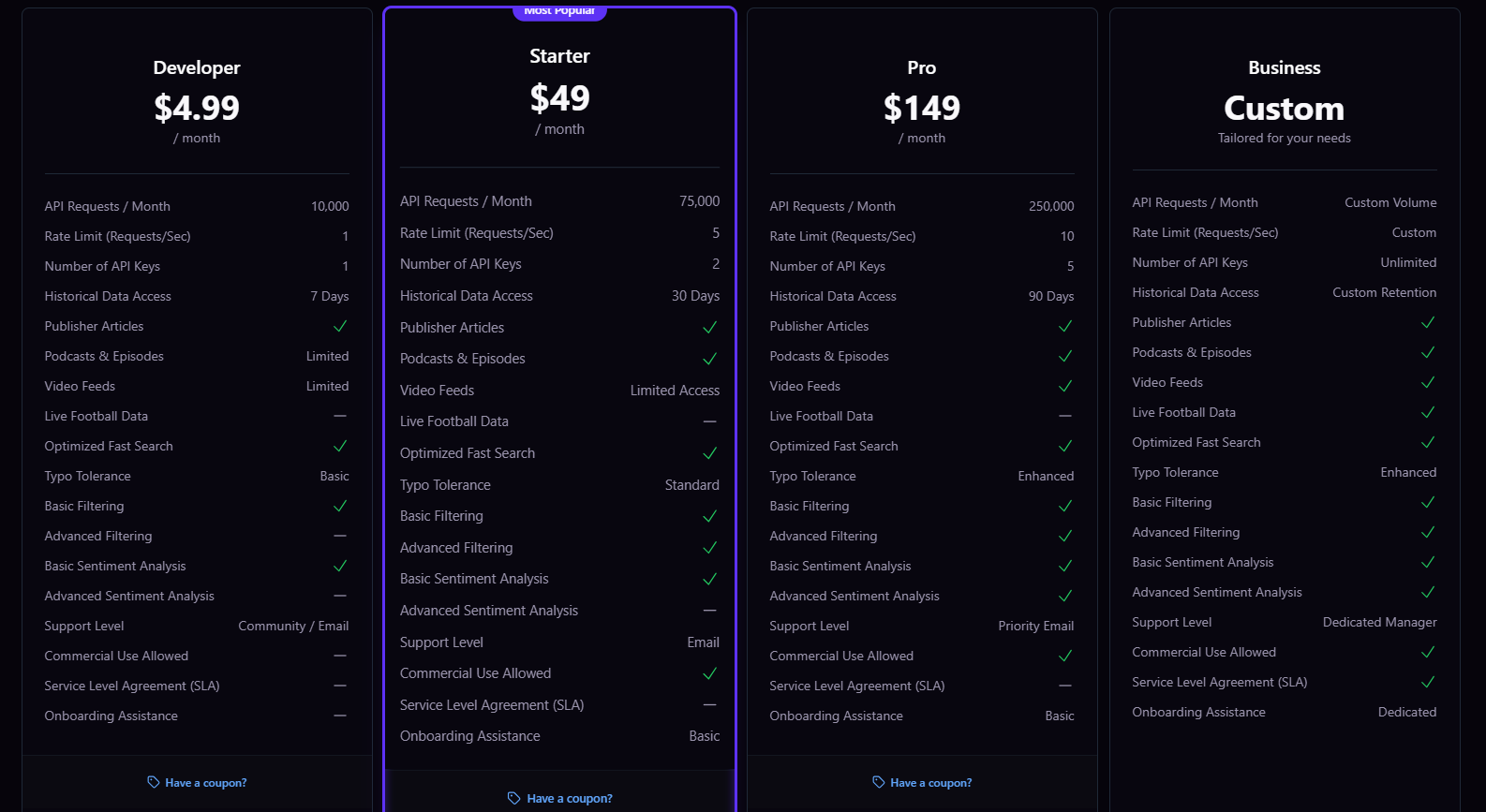
Same API shape at every tier. Same JSON response format. No “congratulations, now rewrite your integration” tax for growing.
Getting started
LumenFeed pulls from 100,000+ sources across 20+ languages, already deduplicated, already structured as JSON, already handling the parts of “just build an RSS scraper” that turn into a second job. Sentiment analysis and typo-tolerant search come standard, so the “advanced filtering” step that usually gets bolted on later is already built in from day one, not a roadmap item you have to wait for.
curl -X GET "https://api.lumenfeed.com/api/v1/articles?q=technology&sort_by=date_desc&per_page=20" \
  -H "X-API-Key: your_api_key_here"
That single request replaces what would otherwise be a dozen separate feed parsers, a deduplication pass, and a cron job babysitting all of it. The response comes back as clean, structured JSON — no XML namespaces to reverse-engineer, no inconsistent date formats to normalize, no guessing which fields a given publisher decided to include this week.
Full pricing and plan details are at lumenfeed.com. If you’re currently mid-scraper and trying to figure out which sites even publish a feed, our guide on finding an RSS feed URL for any website covers that first step, and our breakdown of what’s actually inside a real RSS feed explains most of the format quirks that eat people’s weekends in the first place.
Frequently asked questions
Is there a free RSS feed provider?
Most providers, including LumenFeed, offer a low-cost entry tier rather than a fully free plan — LumenFeed’s Developer plan is $4.99/month for 10,000 requests with no credit card required to start.
How much does it cost to scale to 100,000 articles a month?
On LumenFeed, the Pro plan at $149/month covers 250,000 requests — comfortably past 100,000 articles a month, with a higher rate limit than the entry tier.
Is it cheaper to build my own RSS scraper?
Often not, once server costs and ongoing maintenance time are counted. A single well-behaved source can be cheap to self-host; multiple sources quickly add hidden time and infrastructure costs a flat monthly plan avoids.
Does a managed RSS feed provider handle duplicate stories?
Yes, deduplication across sources covering the same story is one of the core problems a unified content API is built to solve, versus a raw multi-source RSS scrape.
What happens if a source changes its RSS feed format?
With a managed provider, format changes on the source side are handled upstream — your integration keeps receiving the same consistent JSON shape regardless of what changed on the publisher’s end.
Do I need a credit card to try it?
No. LumenFeed’s Developer plan requires no credit card to start testing.




One Comment