
How to Build a Website or App with a News API (Instead of Wiring API to API Yourself)
- The basic shape: your app’s API talking to a news API
- DIY multi-source pipeline vs. one news API
- Building a website with live news content
- Building an app: mobile-specific considerations
- Where the API call actually lives in your stack
- Example: a niche news site or content-driven app
- Getting started
- FAQ
Building a website or app around news content usually starts with a reasonable-sounding plan: pull from a couple of RSS feeds, maybe wire one API’s output into another API to fill gaps, stitch it together with some glue code. That plan holds up for a demo. It stops holding up the moment a second content type — video, podcasts, sentiment — enters the picture, because now you’re not calling one API, you’re maintaining API-to-API plumbing between several, each with its own auth, its own schema, its own rate limits. This is the guide for skipping that step entirely: how to build a website or app powered by a single news API instead of duct-taping several together.
The basic shape: your app’s API talking to a news API
At its simplest, your website or app’s backend makes an API call to a news API, gets back structured JSON, and renders it — a search bar hits an endpoint, results come back, a template turns them into cards or a list. That’s the entire architecture for a basic build. The complexity shows up when you need more than text articles, or more than one region, or more than one language, and start reaching for a second and third API to fill the gaps the first one leaves.
DIY multi-source pipeline vs. one news API
| Approach | Integration effort | |
|---|---|---|
| Multiple APIs wired together | ||
| One content aggregation API |
Bar widths reflect relative integration effort, not a measured benchmark — actual effort varies by how many sources and content types your build needs.
API to API, manually
News articles from one API, video from another, sentiment computed separately — three schemas to reconcile in your own code.
One content aggregation API
Articles, podcasts, videos, and sentiment in the same JSON shape, from a single request.
Building a website with live news content
For a website — a news aggregator, a niche industry blog with a live “latest coverage” section, a research tool — the API call typically lives server-side, on page load or on a schedule that refreshes a cache. Server-side keeps the API key out of the browser and lets you cache results instead of hitting the API on every single page view, which matters once traffic beyond a personal project.
Building an app: mobile-specific considerations
For a mobile app, the same principle applies, but the call almost always goes through your own backend rather than directly from the device — again to protect the API key, but also to let you batch, cache, and paginate results before they hit a phone on a spotty connection. A content-heavy app pulling video or podcasts alongside articles benefits specifically from a unified response, since the app’s UI can render one list instead of merging three separate data shapes from three separate calls.
Where the API call actually lives in your stack
- Your backend receives a request. A user searches, or a scheduled job runs.
- Your backend calls the news API. One request, with a query, language filter, and sort order.
- Your backend caches and returns the result. The frontend or app never talks to the news API directly.
That middle step is the one that gets complicated fast if it’s actually two or three separate API-to-API calls instead of one, each needing its own error handling for when a source is slow or down. Every additional API in that chain is another place a request can time out, another rate limit to track, and another response shape your code has to reconcile before it can render a single unified list to the user.
This is where a lot of “connect your API to another API” tutorials undersell the real cost. Wiring two APIs together for a demo is genuinely quick. Keeping that wiring reliable in production — retrying failed calls, handling a source going down mid-request, merging mismatched schemas — is the part that turns into ongoing maintenance rather than a one-time integration task.
Example: a niche news site or content-driven app
Picture a website covering a specific industry — say, renewable energy. Instead of subscribing to a dozen RSS feeds from trade publications and building a scraper for each, the backend makes a single query for the topic, filtered by language and sorted by recency, and gets back a deduplicated list with sentiment scores already attached — useful if the site wants to separate “positive developments” from “regulatory setbacks” without writing that classification logic itself. This is the same underlying data shape covered in our JSON news feed format breakdown, if you want to see the response structure in more detail before building against it.
Getting started
LumenFeed is built specifically to be the one API a website or app calls instead of several — articles, podcasts, videos, and live sports data from 100,000+ sources in 20+ languages, all in the same JSON shape.
curl -X GET "https://api.lumenfeed.com/api/v1/articles?q=renewable+energy&filter_by=language:=en&sort_by=date_desc" \
  -H "X-API-Key: your_api_key_here"
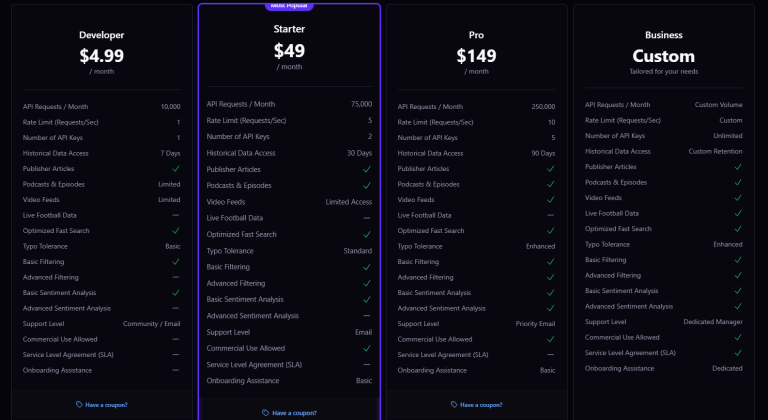
The Developer plan is $4.99/month for 10,000 requests, with no credit card required to start — enough to build and test a real website or app integration before committing to anything. Full docs are at lumenfeed.com. If you’re earlier in the process and still deciding between raw RSS and an API, our piece on what a managed RSS feed provider actually saves you covers that tradeoff, and if you’re comparing options more broadly, our global API comparison lines LumenFeed up against the alternatives on coverage and pricing. For background on how a REST API is conventionally structured, see the Wikipedia entry on REST.
Ready to build?
Skip the API-to-API plumbing and get one key, one schema, and 100,000+ sources behind a single request.
Frequently asked questions
Do I need to call multiple APIs to build a full news app?
Not necessarily. Wiring API to API for every content type adds ongoing integration overhead; a content aggregation API that includes articles, video, and podcasts in one response removes that entirely.
Should my frontend call the news API directly?
Generally no. Routing the call through your own backend keeps your API key private and lets you cache results instead of making a fresh API call on every page view or app screen.
How much does it cost to build a prototype app with a news API?
LumenFeed’s Developer plan is $4.99/month for 10,000 requests, with no credit card required to start testing a prototype.
What’s the difference between building a website vs. an app with a news API?
The API call itself is the same; the main differences are where caching happens and how aggressively a mobile app should batch and paginate results for slower connections.
Can I get sentiment or topic data without building that logic myself?
Yes, some content APIs, including LumenFeed, return sentiment and keyword fields directly in the response, removing the need to build that classification separately.
Is it better to use one unified API or combine several specialized ones?
It depends on how narrow your needs are. For a single content type from a single region, a specialized API can be simpler. For multiple content types or broad language coverage, a unified API reduces integration work significantly.