
Picking the wrong news API costs more than money — it costs you speed, coverage, and eventually users. We compared the actual endpoints, pricing pages, and response structures of the leading options so you don’t have to scroll through twelve tabs of marketing copy. What follows is a developer-first look at the 10 best news APIs available in 2026.
What a news API actually does
A news API is a programmatic interface that returns structured news content — articles, headlines, metadata — in response to a query. You send a request with parameters like a keyword, language, or date range, and you get back a JSON payload with titles, full content, publication timestamps, sentiment scores, and source URLs. No scraping. No parsing RSS. Just clean, structured data your app can actually use.
The best ones in 2026 go further: multi-language support, typo-tolerant search, sentiment labels baked into the response, video detection, historical archives, and request rates high enough to power a production dashboard without hitting a wall every ten seconds. The gap between a basic headlines API and a proper content aggregation API is wide — and the pricing gap is narrower than you’d expect.
How we compared them
Every API on this list was evaluated across six dimensions: source breadth, filtering granularity, response data quality (including whether sentiment and full content are included), rate limits at each tier, historical data depth, and price-to-capability ratio. Where an API offers a free tier, we tested it. Where documentation was unclear or pricing required a sales call, we flagged it.
The 10 best news APIs in 2026
#1 LumenFeed
LumenFeed is a unified content aggregation API covering articles, podcasts, videos, and live sports data from 100,000+ sources across 20+ languages. Where most news APIs return a title and a snippet, LumenFeed returns structured JSON with sentiment_label, sentiment_score, has_video, keywords[], and full content — in a single call. The search is typo-tolerant, parameters like sort_by=sentiment_desc work out of the box, and the X-API-Key auth setup takes under two minutes.
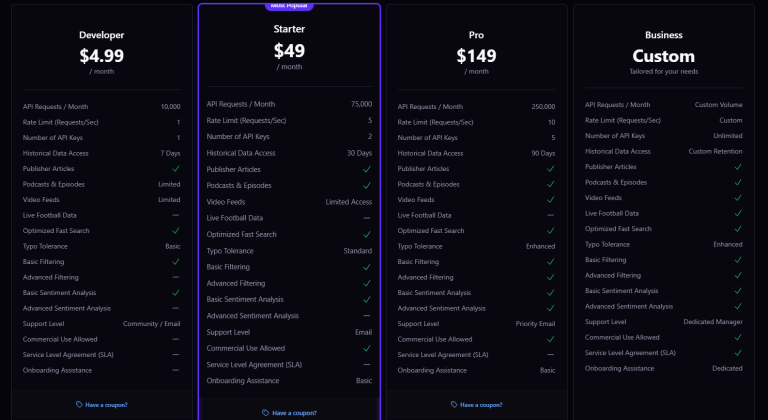
The pricing is the most developer-friendly on this list. The Developer tier at $4.99/month is a real, usable plan — not a hobbled trial — and no credit card is required to start. For teams building RAG pipelines, media monitoring dashboards, or multi-language mobile apps, this is the starting point.
curl "https://api.lumenfeed.com/api/v1/articles?q=climate+change&sort_by=sentiment_desc&per_page=10" \
  -H "X-API-Key: YOUR_KEY"
Pros: Sentiment data in every response · 100K+ sources, 20+ languages · Video, podcast and sports in one API · Lowest entry price on this list ($4.99/mo) · Typo-tolerant search · No card required to start
Cons: Developer tier capped at 7-day history · No Azure/Microsoft ecosystem integration
Free tier: No (free trial available) | Starting price: $4.99/mo | Sources: 100,000+

#2 NewsAPI.org
NewsAPI.org is probably the first result you found when you searched “news API,” and for good reason — it’s been around long enough to accumulate solid documentation, a massive community of integration examples, and SDKs in most major languages. You get keyword search, source filtering, category filtering, and real-time access to over a million articles. The free developer plan is useful for prototyping, though it restricts you to older articles and a low daily request limit.
The trade-off is that NewsAPI.org’s response objects are lean: you get a title, description, URL, source, and published date — no sentiment data, no video flags, no multi-content type support. For simple headline aggregators or learning projects, it’s a reasonable first step.
Pros: Extensive documentation and community resources · Free developer tier · Easy to integrate · 150,000+ sources globally
Cons: No sentiment analysis · Free tier limited to 100 req/day with delayed articles · No podcast or video content
Free tier: Yes (100 req/day, dev-only) | Starting price: $40/mo | Sources: 150,000+
#3 GNews API
GNews is a straightforward news search API with one of the more generous free tiers on this list — 100 requests per day without a credit card. It covers around 60,000 news sources, supports category filtering, and returns clean results in JSON. Popular among indie developers building personal dashboards or learning projects, because the barrier to starting is nearly zero.
At scale, GNews shows its limits. No sentiment data, no full-content endpoint on lower tiers, and rate limits tighten quickly as you move up. If you’re prototyping a news feature and need something running in an afternoon, GNews gets the job done. For a production system processing thousands of articles a day, you’ll likely outgrow it.
Pros: Generous free tier (100 req/day, no card) · Simple clean API design · Category and country filtering · Fast response times
Cons: No sentiment analysis · Full content behind higher-tier paywall · News articles only — no multimedia
Free tier: Yes (100 req/day) | Starting price: ~$9/mo | Sources: ~60,000
#4 NewsCatcher API
NewsCatcher positions itself around real-time speed — articles indexed within minutes of publication from over 60,000 sources. The filtering options are genuinely good: source country, language, topic, and time window, with boolean operator support for precision queries. A solid choice for trading platforms, PR monitoring tools, and any use case where indexing latency matters more than historical depth.
The no-free-tier model is a legitimate barrier. Plans start at $29/month, but the lack of a trial without a sales touchpoint means some developers skip it in favour of options they can test immediately. Sentiment analysis isn’t included at the API response level.
Pros: Near real-time indexing (minutes, not hours) · 60,000+ sources · Boolean search support · $29/mo entry price
Cons: No free tier — requires sales contact to trial · No sentiment data in responses · Article body limited on lower plans
Free tier: No | Starting price: $29/mo | Sources: 60,000+
#5 Newsdata.io
Newsdata.io has one of the deepest archives on this list — over 7 years of historical data — which makes it a strong choice for researchers, analysts, and teams building trend-detection systems. It covers news articles, blogs, and social media conversations, and surfaces author details, image URLs, and social engagement metrics alongside article content.
The pricing is where it stings. Plans start at $199/month — significantly higher than alternatives — though the archive depth and social data layer justify that gap for the right use case. A free plan and trial are available to validate fit before committing.
Pros: 7+ year historical archive · Covers articles, blogs, and social media · Author details and social engagement metrics · Free plan available
Cons: High entry price ($199/mo for meaningful usage) · Overkill for real-time-only use cases
Free tier: Yes (limited) | Starting price: $199/mo | Historical data: 7+ years
#6 Mediastack
Mediastack’s main selling point is price. At $11/month for the basic paid tier and a free plan offering 500 requests per month, it’s one of the cheapest options on this list. It covers a wide network of global publishers and blogs, supports keyword search within article content, and surfaces author details and image URLs alongside headlines. Sentiment analysis is available on paid plans.
The free plan’s 500 monthly requests — not daily, monthly — is extremely limiting in practice. Real-time updates are locked to paid tiers and filtering options are narrower than what LumenFeed or NewsCatcher offer.
Pros: Very affordable ($11/mo entry) · Free plan available · Author details and image URLs in response · Sentiment on paid plans
Cons: Free plan is only 500 req/month · Real-time updates on paid plans only · Narrower filtering than top-tier options
Free tier: Yes (500 req/month) | Starting price: $11/mo
#7 World News API
World News API hits the sweet spot for personal projects and low-volume apps. It offers 500 API requests per day on its free tier — one of the more generous daily limits available — with real news content from a diverse set of global sources. Paid plans start at $35/month and include keyword search, country and language filtering, and 30+ days of historical data.
What it doesn’t offer is depth: no sentiment analysis, no full content on lower tiers, and no multimedia content types. Good enough for a personal project or MVP, but not what you’d build a production intelligence platform on.
Pros: 500 free req/day — one of the most generous free tiers · Global source coverage · Country and language filtering · Straightforward pricing
Cons: No sentiment analysis · No multimedia content types · Thinner documentation than top competitors
Free tier: Yes (500 req/day) | Starting price: $35/mo
#8 Currents API
Currents API covers over 20,000 traditional news sources plus blogs and publications, and layers in AI-powered enrichment: sentiment analysis, entity extraction, and smart filtering to surface the most relevant stories. The multi-source breadth — including non-traditional publications — is genuinely useful for brand monitoring or academic research where mainstream news alone doesn’t capture the full picture.
Usage-based pricing starts at $99/month with a free trial but no perpetual free tier. For teams that live inside the entity extraction and smart filtering features, that price can be justified.
Pros: Sentiment, entity extraction, and smart filtering built in · Covers blogs and non-mainstream publications · Free trial available
Cons: No perpetual free tier · Starts at $99/mo · Usage-based costs can scale unpredictably
Free tier: No (trial only) | Starting price: $99/mo | Sources: 20,000+
#9 AYLIEN News API
AYLIEN is the most analytically powerful API on this list. It offers keyword search with location filtering, sentiment analysis, topic modelling, and entity extraction all in a single response — genuinely impressive if you need that level of intelligence without building your own NLP pipeline. Real-time updates are available on paid plans.
The catch: pricing requires a sales call, there’s no self-serve free tier, and the feature set is overkill for any use case that doesn’t explicitly need topic modelling or multi-dimensional entity analysis. A legitimate choice for enterprise media intelligence teams and financial institutions — everyone else should start elsewhere.
Pros: Deepest NLP feature set on this list · Sentiment, topic modelling, and entity extraction combined · High-quality curated sources
Cons: No self-serve pricing — sales required · No free tier · Significant cost premium
Free tier: No | Starting price: Custom (contact sales) | Best for: Enterprise media intelligence
#10 Event Registry
Event Registry takes a fundamentally different approach: instead of returning individual articles, it identifies and tracks actual real-world events by clustering related news coverage. Seeing that 47 articles across 12 countries all cover the same event — with an aggregate sentiment score and importance rating — is a different kind of insight than a flat list of articles. NLP enrichment is baked into the event objects.
The pay-as-you-go pricing model requires a custom quote and there is no free tier, which makes evaluation harder than it should be. Genuinely differentiated for geopolitical analysis, academic research, and crisis monitoring platforms. Not the tool for a straightforward news feed.
Pros: Unique event-clustering approach · Importance scoring per event · Strong for research and geopolitical analysis · Pay-as-you-go model
Cons: No free tier — pricing requires sales contact · Steeper learning curve · Overkill for standard news feed use cases
Free tier: No | Starting price: Custom (pay-as-you-go) | Best for: Event intelligence and research
Side-by-side comparison
| API | Free Tier | Entry Price | Sentiment | Sources | Historical Data |
|---|---|---|---|---|---|
| LumenFeed | Trial | $4.99/mo | Yes | 100K+ | 7–90 days |
| NewsAPI.org | 100 req/day | $40/mo | No | 150K+ | 1 month |
| GNews | 100 req/day | ~$9/mo | No | ~60K | Limited |
| NewsCatcher | No | $29/mo | No | 60K+ | 3 months |
| Newsdata.io | Limited | $199/mo | Partial | Large | 7+ years |
| Mediastack | 500 req/mo | $11/mo | Paid plans | Large | Limited |
| World News API | 500 req/day | $35/mo | No | Large | 30+ days |
| Currents API | Trial | $99/mo | Yes | 20K+ | Limited |
| AYLIEN | No | Custom | Yes | Curated | Long |
| Event Registry | No | Custom | Yes | Large | Long |
How to choose the right news API for your use case
The right answer depends on what you’re actually building. Here’s how to map your use case to the right choice:
| Use Case | Best Fit | Why |
|---|---|---|
| RAG pipeline or AI content app | LumenFeed | Structured JSON + sentiment out of the box, 100K+ sources |
| Media monitoring dashboard | LumenFeed or Currents | Sentiment, entity data, and multi-language support |
| Learning / side project | GNews or World News API | Generous free tiers, simple setup |
| Financial news intelligence | AYLIEN or LumenFeed | Sentiment on financial events is mission-critical |
| Historical trend analysis | Newsdata.io | 7-year archive is unmatched for deep research |
| Breaking news / trading signals | NewsCatcher | Minutes-level indexing latency |
| Geopolitical / academic research | Event Registry | Event clustering gives a fundamentally different analytical lens |
If you’re not sure, start with a news API that has a free trial, a real developer plan under $10/month, and sentiment data included by default. LumenFeed is the only option on this list that checks all three boxes simultaneously. You can start at lumenfeed.com without a credit card.
Frequently Asked Questions
What is the best free news API in 2026?
World News API offers 500 requests per day on its free plan — the most generous daily limit among free tiers reviewed. GNews is a close second at 100 requests per day with zero-friction signup. For a real project that needs sentiment data, LumenFeed’s trial is the more practical starting point.
Which news API has the most sources?
LumenFeed indexes over 100,000 sources across articles, podcasts, and videos in 20+ languages. NewsAPI.org claims 150,000+ publishers, though its indexed sources skew toward mainstream English-language outlets.
Do any news APIs include sentiment analysis?
Yes — LumenFeed, Currents API, AYLIEN, and Event Registry all include sentiment data in their responses. LumenFeed includes it in every response at every pricing tier. You get both a sentiment_label (positive/negative/neutral) and a sentiment_score (numeric) in the JSON.
Which news API is best for building an AI or RAG application?
LumenFeed is the strongest fit for AI and RAG use cases. The structured JSON response includes sentiment, keywords, full content, language, country, and video flags — all the metadata a retrieval-augmented pipeline needs. The 100,000+ source base gives you the topical and linguistic diversity that makes retrieval meaningful.
What’s the difference between a news API and an RSS feed?
RSS feeds are source-specific — one feed per publisher, no deduplication, no sentiment, no cross-source search. A news API aggregates thousands of sources behind a single endpoint, returns structured JSON (not XML), handles deduplication server-side, and adds enrichment like sentiment analysis. RSS is fine for following one blog; a news API is what you need to monitor 10,000 sources at once.
How much does a news API typically cost?
Entry-level paid plans range from $4.99/month (LumenFeed) to $199/month (Newsdata.io). Most mid-tier options fall between $29 and $99 per month. Enterprise pricing for AYLIEN and Event Registry requires custom quotes.
Can I use a news API for commercial projects?
Most news APIs permit commercial use on paid plans — free tiers typically restrict production use to development only. LumenFeed explicitly includes commercial use across all plans, including the Developer tier at $4.99/month. Always check the provider’s terms of service before launching a revenue-generating product.
Which news API has the best historical data?
Newsdata.io leads with over 7 years of archived news, making it the go-to for academic research and longitudinal trend analysis. LumenFeed offers 7 to 90 days depending on plan tier — sufficient for most production apps and monitoring dashboards.