

A team building a media-monitoring dashboard signs up for GNews API on a Tuesday. By Thursday, they’ve hit their free-tier request cap testing basic queries, and they’re realizing the plan only covers news articles — no podcasts, no video flags, no live sports data for the client’s sports-brand monitoring use case. They didn’t pick the wrong tool exactly. They picked a tool sized for a narrower job than the one they actually had.
That’s the pattern behind most “gnews api” searches that end in frustration. The problem wasn’t that GNews API is bad at what it does. It’s that what it does — text-only news search — is often smaller than what people actually need once they start building. The gap usually doesn’t show up in the sales page or the docs; it shows up a few weeks in, once the prototype needs to become something a client actually relies on.
What does GNews API actually cover?
GNews API is a text-focused news search API — you send a query, it returns matching news articles with basic metadata like title, source, and publish date. It’s a reasonable starting point for a simple “search recent news” feature, and its free tier is genuinely useful for prototyping.
Why “just use GNews” seems like the obvious call
It’s the first result for “news api” in a lot of searches, the docs are simple to read, and for a weekend project that only needs article headlines, it does the job without much setup. If your entire use case is “show me recent articles matching a keyword,” there’s a real argument for starting there and moving on only if you outgrow it.
Where teams actually hit friction
1. Content type is narrower than the use case. A lot of products that start as “just show news” end up needing podcasts, video content, or live sports data within a few months — none of which a text-only news API can provide without bolting on a second, third, and fourth API.
2. No sentiment or tone filtering. Media monitoring and brand-tracking use cases usually want to know not just that a story exists, but whether the coverage is positive or negative. A plain article feed can’t answer that question without external processing.
3. Free-tier limits hit fast in testing. Prototyping means running the same query repeatedly while you tune filters. A request cap sized for light production use, not iterative development, turns testing itself into a bottleneck.
Text-only news API
One content type. No sentiment field. Query again elsewhere for podcasts, video, or sports data.
Unified content API
Articles, podcasts, videos, and live sports in one JSON shape, with sentiment already attached.
4. Source diversity varies by plan. Broader coverage — smaller regional publishers, non-English sources, niche trade press — is often gated behind higher tiers or simply out of scope, which matters if your monitoring use case cares about long-tail sources, not just major outlets.
5. Deduplication isn’t guaranteed across sources. When the same story runs on multiple outlets, a basic news search API may return each version as a separate result. For a monitoring dashboard trying to count real mentions rather than republished copies, that inflates numbers in a way that’s easy to miss until someone double-checks the math.
How to actually evaluate a news API before committing
Rather than picking based on which result ranks first, it helps to test against your real use case before signing up for a paid tier. A few concrete things worth checking:
- List your actual content types. If you’ll ever need podcasts, video, or sports data alongside articles, confirm the provider covers all of them now — not as a future roadmap item.
- Check the metadata fields, not just the article text. Sentiment, language, and country tags matter more than raw headline count once you’re filtering or building a dashboard.
- Test the free tier against your real query volume. A cap that looks generous on paper can disappear fast once you’re iterating on filters during development, not just running the app in production.
- Ask about deduplication explicitly. It’s rarely advertised as a headline feature, but it’s often the difference between clean data and a noisy feed.
GNews API vs. a unified content API
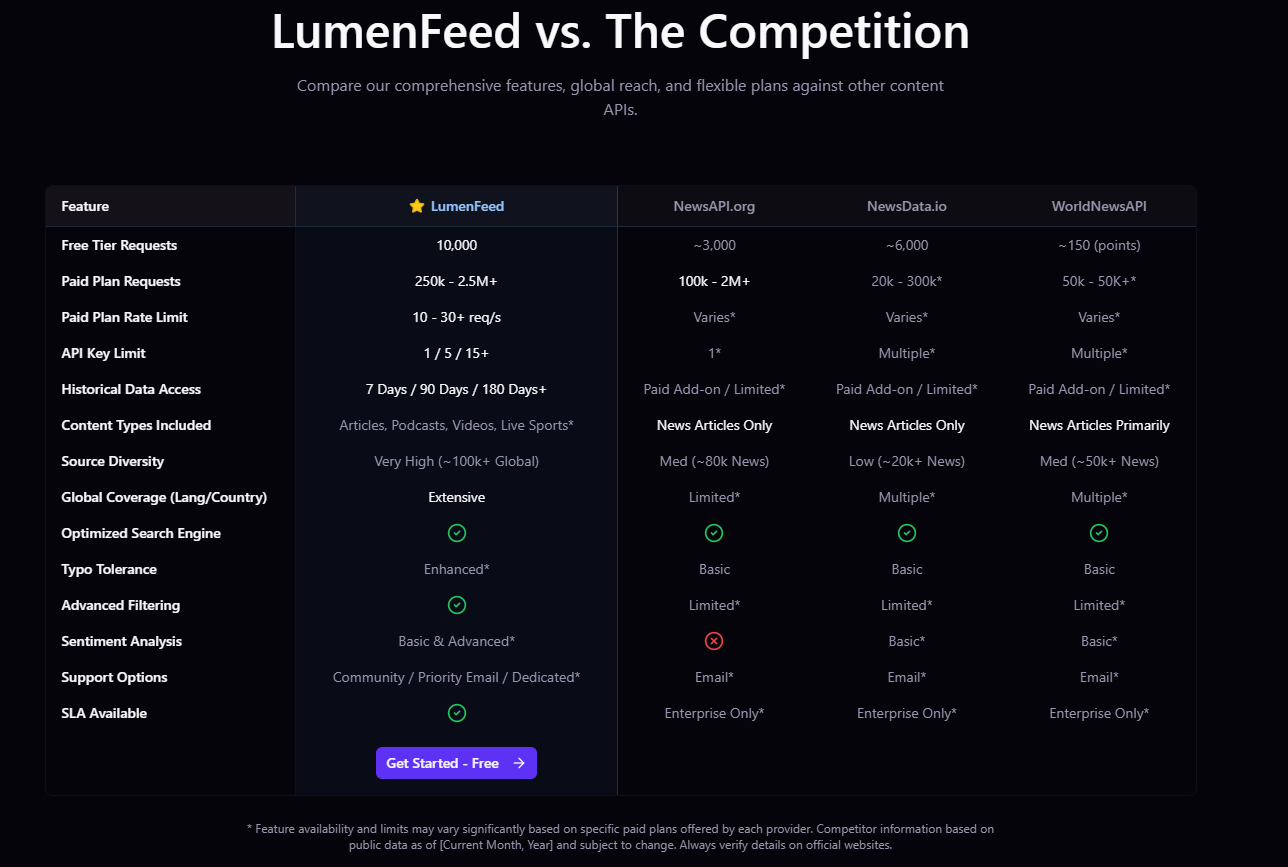
| Capability | GNews API | LumenFeed |
|---|---|---|
| Content types | News articles only | Articles, podcasts, videos, live sports |
| Sentiment analysis | Not included | Included on every article |
| Language coverage | Limited by plan | 20+ languages, filterable |
| Historical backfill | Limited on lower tiers | 7–90+ days by plan |
| Commercial use on entry tier | Varies by plan terms | Included on all plans, from $4.99/mo |
To be fair, if your product genuinely only needs text article search in a handful of major languages, GNews API’s simplicity is a real advantage — you’re not paying for capability you won’t use. The comparison above only matters once your use case actually needs the extra content types or metadata. Plenty of small internal tools and side projects never reach that point, and that’s fine — the mismatch only becomes a real cost once a client or production feature depends on data the API was never built to provide.
A brand monitoring dashboard, in practice
Say the same team from the opening scenario is tracking mentions of a client’s brand across news coverage. With a text-only news search, their pipeline looks like: query articles, manually tag sentiment by reading each one, cross-reference for duplicate coverage of the same story, then build the dashboard on top of that manually cleaned data. Every new mention means repeating the manual sentiment pass.
With sentiment and deduplication handled at the API layer, that same pipeline becomes: query once with a sentiment sort, get back a clean, deduplicated list, plug it straight into the dashboard. The manual cleanup step disappears entirely — not because the dashboard got smarter, but because the data arriving was already in the shape the dashboard needed.
Getting started with a broader API
LumenFeed is built for exactly the cases where a text-only news API runs out of room: media monitoring that needs sentiment, apps that mix articles with podcasts or video, and anything touching live sports data alongside editorial coverage. One API key, one JSON shape, 100,000+ sources across 20+ languages.
curl 'https://api.lumenfeed.com/api/v1/articles?q="brand mention"&filter_by=language:=en&sort_by=sentiment_desc' \
  -H 'X-API-Key: YOUR_KEY'
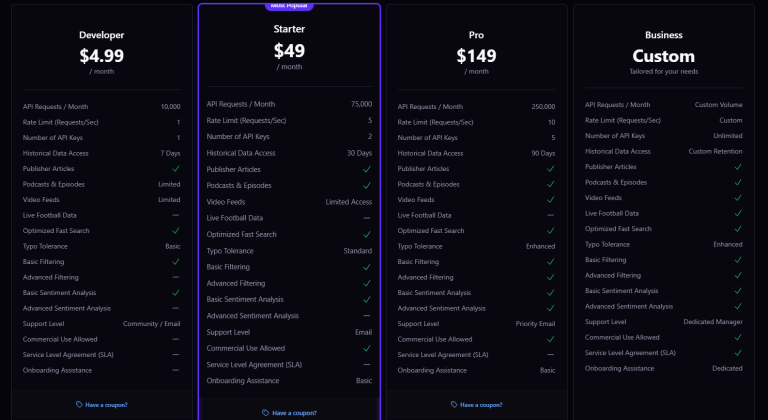
The Developer plan is $4.99/month for 10,000 requests — enough to test real queries without hitting a wall halfway through prototyping. No credit card required to start. Full plan details at lumenfeed.com.
If you’re earlier in the pipeline and still assembling raw feeds, our guide on what a JSON news feed actually contains covers the data shape question directly. And if deduplication across multiple sources is your actual pain point rather than content type, see how that’s handled in our piece on automating RSS to newsletter pipelines. For an independent reference on how news APIs are typically evaluated, the Wikipedia entry on APIs covers the general concept these comparisons build on.
Frequently asked questions
Is GNews API free to use?
GNews API offers a free tier with limited requests, suitable for testing. Production use and higher volume typically require a paid plan.
What’s a good gnews api alternative for media monitoring?
For monitoring use cases that need sentiment scoring and multi-content-type coverage, a unified API like LumenFeed is a stronger fit than a text-only news search API.
Does GNews API support sentiment analysis?
No, GNews API returns article metadata like title and source but doesn’t include sentiment scoring. That requires either a separate sentiment API or a provider that includes it natively.
Can I get podcasts or video content from a news API?
Text-only news APIs like GNews don’t cover podcasts or video. A broader content aggregation API can return all three content types from the same endpoint.
How many languages does GNews API support?
Language support varies by plan and is generally more limited than providers built specifically around multi-language coverage — worth checking current plan details directly before committing.
Is there a free way to try a gnews api alternative?
Yes. LumenFeed’s Developer plan is $4.99/month for 10,000 requests, with no credit card required to start testing.
What should I check before switching providers?
Confirm the new provider covers your actual content types (not just articles), includes the metadata fields you need like sentiment or language tags, and offers enough free-tier requests to properly test before committing.
None of this makes GNews API a bad tool — for a narrow, text-only news search feature, it’s a reasonable, well-documented option. The gap only shows up once your product needs more content types, sentiment data, or broader language coverage than a news-only API was built to provide. If that’s where you’ve landed, LumenFeed is built for that wider scope — see how it works at lumenfeed.com.





2 Comments